
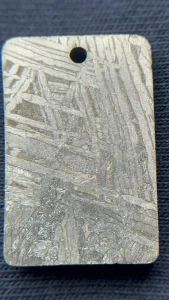
Real meteorite jewelry is not difficult to identify — if you know what to look for. The Widmanstätten pattern in genuine iron meteorite forms over millions of years of cooling inside an asteroid’s core. It has physical properties that no manufacturing process can replicate. This guide covers five verification methods, ranked from most to least reliable.
Why Most Basic Tests Are Not Enough
The two tests most commonly recommended online — magnet test and visual pattern check — are necessary but not sufficient.
Magnet test: Genuine iron meteorite is strongly magnetic due to its iron-nickel composition. A magnet will stick firmly, not just weakly attract. However, many fake meteorite products are also made from magnetic steel alloys. Passing the magnet test confirms the piece contains iron. It does not confirm the piece is meteorite.
Visual pattern check: Genuine Widmanstätten pattern is geometric and complex. But laser etching and acid etching of steel can produce patterns that photograph convincingly. A pattern that looks right in a product image is not verification.
These two tests together eliminate obvious fakes. They do not eliminate sophisticated ones.
The Five-Method Verification Framework
Method 1: Bandwidth Measurement (Most Reliable)
The single most reliable physical test for Aletai iron meteorite specifically is kamacite bandwidth measurement.
In genuine Aletai meteorite, kamacite bands measure 0.9–1.4 mm in width. This places it on the coarse–medium boundary rather than a simple coarse-only structural label. The bands are wide enough to measure with a standard ruler against a printed photo, or with digital calipers on the physical piece.At Movalor, each piece is made with Aletai meteorite, a specific iron meteorite found in the Aletai region of Xinjiang, China.
Laser-etched steel fakes typically show one of two failure patterns: bands that are too uniform in width (natural kamacite varies slightly across the surface), or bands that are too narrow (attempting to imitate finer meteorite types like Muonionalusta at 0.23–0.43 mm, which are more commonly counterfeited due to their finer appearance).For long-term wearing and care guidance, see Movalor’s Materials & Care page.
If the seller cannot tell you the kamacite bandwidth, that is itself a data point.
Method 2: Chatoyancy Under Directional Light (High Reliability)
This is the test most buyers never perform — and the one fakes most consistently fail.
Hold the piece under a single directional light source (a phone flashlight works). Rotate it slowly. In genuine Widmanstätten pattern, the kamacite bands and taenite bands reflect light at different angles. As you rotate the piece, you will see the pattern appear to shift — bands that were bright become dark, and adjacent bands brighten. This is because kamacite and taenite are physically distinct metal phases with different crystallographic orientations. They are not the same material etched to different depths.
Laser-etched steel has a single metal phase throughout. Rotating it under directional light produces uniform reflection across the surface — the pattern does not shift. The apparent depth is an optical illusion created by surface texture, not by two physically distinct materials reflecting differently.
This test requires no equipment. It requires thirty seconds and a flashlight.
Method 3: Pattern Continuity Through the Cross-Section
In genuine iron meteorite, the Widmanstätten pattern extends through the entire thickness of the piece. The kamacite and taenite bands are not surface features — they are the internal crystal structure of the metal, visible wherever the material is cut.
Examine the edge of the piece. In genuine Aletai meteorite, you can see the band structure continuing into the cross-section. The bands that appear on the face of the pendant continue as visible lines through the edge thickness.
In laser-etched pieces, the pattern exists only on the treated surface. The edge will show uniform, unstructured metal.
Method 4: Inclusion Identification
Genuine iron meteorite contains inclusions — small dark spots or irregular areas where troilite (iron sulfide) or schreibersite (iron-nickel phosphide) phases are embedded in the metal matrix. These appear as dark nodules or irregular patches within the crystal structure, typically 0.5 to 3 mm in diameter.
Inclusions are not defects. They are evidence of the original asteroid chemistry — minerals that crystallized alongside the iron-nickel metal over billions of years.
Etched steel contains no such inclusions. A piece with a perfect, uninterrupted pattern and no visible inclusion sites warrants closer examination.
Method 5: Documentation Request
Ask the seller for the meteorite classification. Genuine Aletai meteorite is classified as Iron, IIIE-an in the Meteoritical Bulletin database — the international registry maintained by the Meteoritical Society. A seller working with genuine Aletai should be able to state the classification, the nickel content (9.8 wt%), and ideally reference the Meteoritical Bulletin entry.
This is not a physical test. But a seller who cannot answer basic classification questions about the material they are selling is telling you something important.
What Laser Etching Actually Looks Like
Laser etching produces a pattern by burning the metal surface to different depths. The result is a texture — raised and recessed areas that create a visual pattern under normal light. It photographs well. It does not withstand the chatoyancy test.
The specific visual difference: laser-etched pattern has hard, defined edges between the “bands.” The burned areas have a slightly granular texture visible under magnification. Natural Widmanstätten bands have gradual transitions at the taenite-kamacite boundaries — the two phases interlock at a crystallographic level, and the boundary between them is a thin transition zone, not a sharp line.
Under a 10x loupe or phone camera macro mode, this difference is visible.
Why High Temperature Permanently Destroys the Pattern
This is the definitive test that cannot be faked in either direction.
The Widmanstätten pattern forms because kamacite and taenite unmix from a single iron-nickel phase (called taenite) as the metal cools below approximately 700°C — a process that took millions of years at 10 to 40°C per million years.
If genuine meteorite is heated above approximately 600°C, the kamacite and taenite phases begin to re-homogenize. The pattern blurs and eventually disappears permanently. There is no way to restore it. The crystal structure that took millions of years to form is destroyed in minutes.
This means: a piece being sold as genuine meteorite that shows any signs of heat treatment — discoloration, bluing, or a pattern that appears partially faded — has been permanently compromised. Buy from sellers who understand this and handle their material accordingly.
It also means: there is no manufacturing shortcut to creating genuine Widmanstätten pattern. You cannot heat-treat steel into meteorite. The physics do not permit it.
A Note on Rust as Authenticity Evidence
Genuine iron meteorite has the reactive iron-nickel structure and chloride susceptibility that produce characteristic oxidation patterns under humid conditions. A piece that shows small reddish-brown spots at inclusion sites, or along crystal boundaries, is behaving exactly as genuine iron meteorite should.
A piece that never oxidizes under any conditions — particularly one stored without protection in a humid environment — may warrant examination. Etched steel oxidizes slowly and uniformly if at all. Genuine iron meteorite oxidizes in the distinctive spot pattern described above.
This is not a definitive test on its own. But it is consistent information.View Movalor’s Aletai iron meteorite pendants.
Summary: What to Ask Before You Buy
Before purchasing meteorite jewelry, ask the seller:
What is the meteorite classification? (For Aletai: Iron, IIIE-an) What is the kamacite bandwidth? (For Aletai: 0.9–1.4 mm) What surface protection is applied? (Renaissance Wax or equivalent museum-grade protection) Is documentation available referencing the Meteoritical Bulletin?
A seller who can answer all four questions is working with genuine material and understands it. A seller who cannot answer the first two is worth approaching with caution.
Already Have a Meteorite Pendant?
If you already own a pendant and want to examine the finished piece more closely, read our meteorite pendant authentication guide. This buyer’s guide focuses on how to evaluate a seller before purchase; the pendant guide focuses on what to check once the piece is already in hand.
FAQ
How can you tell if meteorite jewelry is real? The most reliable methods are: measuring kamacite bandwidth (Aletai should measure 0.9–1.4 mm), performing the chatoyancy test under directional light (genuine two-phase metal shifts; etched steel does not), examining edge cross-section for pattern continuity, and identifying inclusion sites within the crystal structure.
Does real meteorite stick to a magnet? Yes — iron meteorite is strongly magnetic. However, magnetic attraction alone does not confirm authenticity, as many steel alloys are also magnetic. The magnet test eliminates obvious non-metallic fakes but should be combined with other methods.
What is chatoyancy in meteorite jewelry? Chatoyancy refers to the optical effect where the Widmanstätten pattern appears to shift under directional light as the piece is rotated. It occurs because kamacite and taenite are physically distinct metal phases that reflect light at different angles. This effect cannot be replicated by laser etching or surface treatment.
Can fake meteorite jewelry pass the magnet test? Yes. Steel alloys used in some fake meteorite products are also magnetic. The magnet test is a necessary first step, not a definitive verification.
Does heating meteorite destroy the Widmanstätten pattern? Yes, permanently. The pattern forms as iron-nickel metal cools over millions of years. Heating above approximately 600°C causes the kamacite and taenite phases to re-homogenize. The pattern cannot be restored. This is why responsible sellers avoid any heat treatment during fabrication.
Explore Movalor Pieces
Once you know what to look for, here is what Movalor offers.
The Quiet Tag
Aletai Meteorite Dog Tag Necklace Identity, memory, presence. The Quiet Pair Matching Aletai Dog Tags Two people, shared meaning. The North Star Aletai Meteorite Star Pendant Direction and clarity. The Ridge Aletai Meteorite Bar Pendant Distance, patience, arrival.