
Making meteorite jewelry is not like working with gold or silver. Aletai iron meteorite — the material in every Movalor pendant — is brittle, heat-sensitive, chemically unstable, and filled with invisible fracture lines formed by asteroid impacts billions of years ago. A single error at any stage is permanent. There is no melting it down and starting over. This is a material that does not forgive.
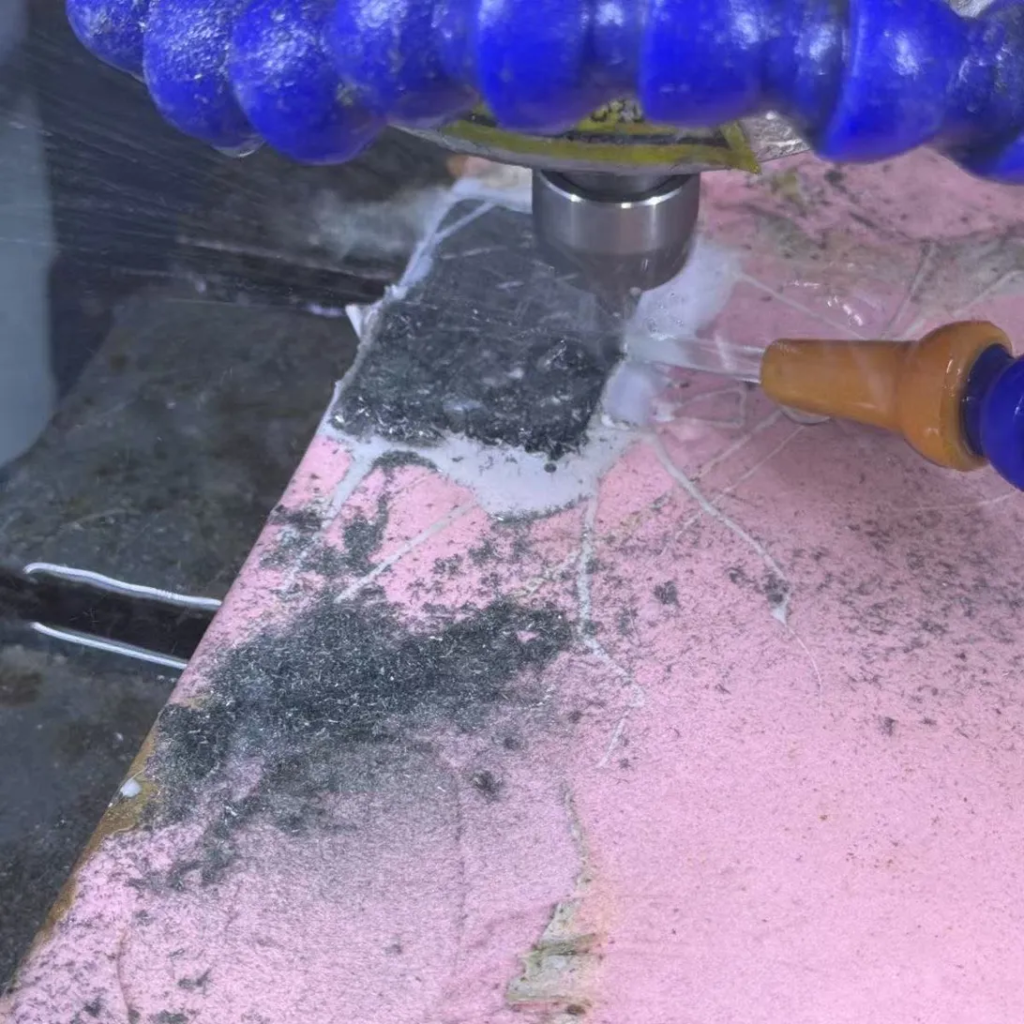
The Cutting Problem: Why Standard Metal Tools Destroy the Pattern
The Widmanstätten pattern that makes Aletai meteorite visually distinctive is not on the surface. It exists throughout the full depth of the metal — a crystalline structure that took between 10 and 40°C of cooling per million years to form. To reveal it, the meteorite must be cut open.
Standard metal cutting methods — abrasive saws, band saws, angle grinders — produce enormous heat at the cutting surface. That heat is the problem. When temperatures in the cut zone exceed 450°C, the atomic structure of the iron-nickel alloy begins to destabilize. The boundary lines between kamacite and taenite — the two crystal phases that create the visible pattern — start to blur and merge. At 700°C, the transformation is complete and irreversible: the Widmanstätten structure collapses into an undifferentiated iron-nickel alloy. The pattern is gone. The meteorite becomes, in material terms, an ordinary piece of metal.
Beyond heat, conventional cutting also produces significant material loss. A standard abrasive blade removes between 1.5 mm and 3.0 mm of material per cut as pure waste. For a meteorite priced by the gram and irreplaceable in origin, that loss is not acceptable.
The solution is diamond wire cutting: a continuous loop of steel wire embedded with industrial diamond particles, moving in a single direction at controlled speed. The wire removes material in microscopic increments, generating almost no heat. Kerf loss drops to between 0.15 mm and 0.6 mm — roughly one-tenth of conventional methods. The crystalline structure survives intact.
Hidden Fractures: The Damage You Cannot See Before You Cut
Every Aletai meteorite carries internal fracture lines invisible to the naked eye. These are called Neumann lines — thin planes of mechanical twinning created when the parent asteroid was struck by other high-velocity objects during the early solar system. The impact sent shockwaves through the metal body at temperatures near absolute zero, forcing the iron crystal lattice to shear along specific crystallographic planes. Those shear planes remain locked inside the meteorite today.
When a cutting tool applies mechanical stress — particularly the vibration and pressure of conventional saws — that stress travels along these pre-existing fracture planes. The result is unpredictable: a piece that appears solid can crack mid-cut, split along an internal plane, or shed a brittle inclusion without warning. There is no way to fully map these fractures before cutting begins.
Diamond wire cutting minimizes this risk because it applies uniform, low-amplitude force rather than high-frequency vibration. But the fractures remain. They are part of the material. Any piece that survives the cutting process without splitting has already passed a test that many pieces fail.
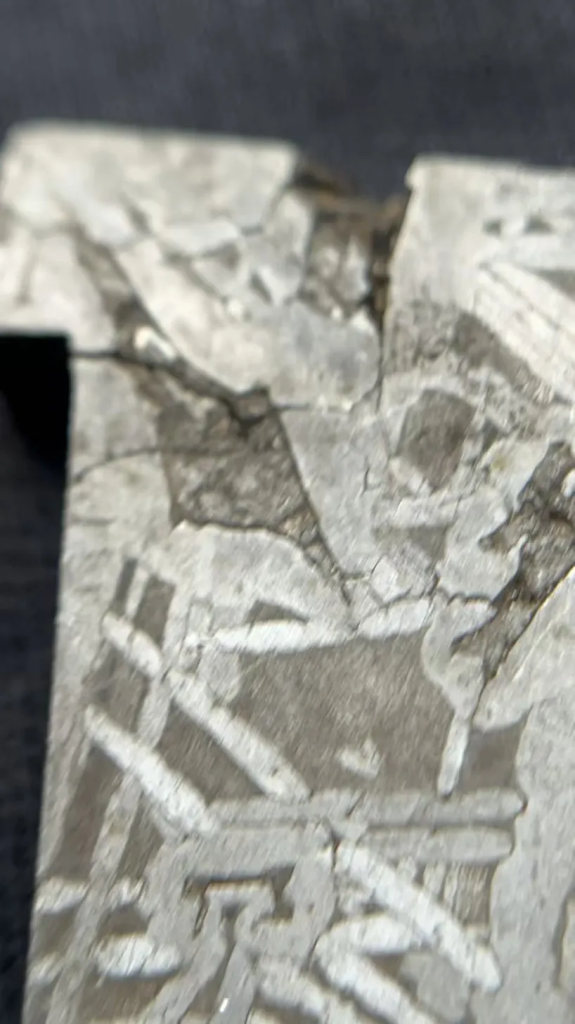
Acid Etching: Revealing Structure, Not Drawing It
After cutting, the meteorite surface is polished to a mirror finish. At this stage, the Widmanstätten pattern is invisible. The kamacite and taenite phases are present throughout the metal, but the surface shows only an undifferentiated silver-grey plane.
Acid etching makes the pattern visible — but it does not create it. The process works through electrochemical corrosion. When an acid solution contacts the polished surface, the two crystal phases respond differently. Kamacite, the iron-rich phase, acts as the anode in a micro-galvanic cell: it loses electrons, oxidizes, and dissolves selectively. Taenite, the nickel-rich phase, acts as the cathode: it resists the acid and remains at its original height.
The result is a topographic map of the crystal structure. The kamacite bands are etched down; the taenite bands stand proud. Light hitting these different surface levels reflects at different angles, and the Widmanstätten pattern — present throughout the full depth of the metal, unchanged since the meteorite cooled in space — becomes visible.
The acid used is typically Nital: a mixture of 1% to 10% nitric acid in anhydrous ethanol, applied for one to ten minutes depending on the specific composition of the meteorite. Water-based solutions are avoided because water drives immediate surface rusting. After etching, the piece is neutralized in a 10% sodium hydroxide solution and baked at controlled temperatures — between 65°C and 120°C depending on thickness — to drive off all residual moisture from the porous metal structure. Moisture left inside initiates corrosion from within.
What the Process Costs: Yield and Material Loss
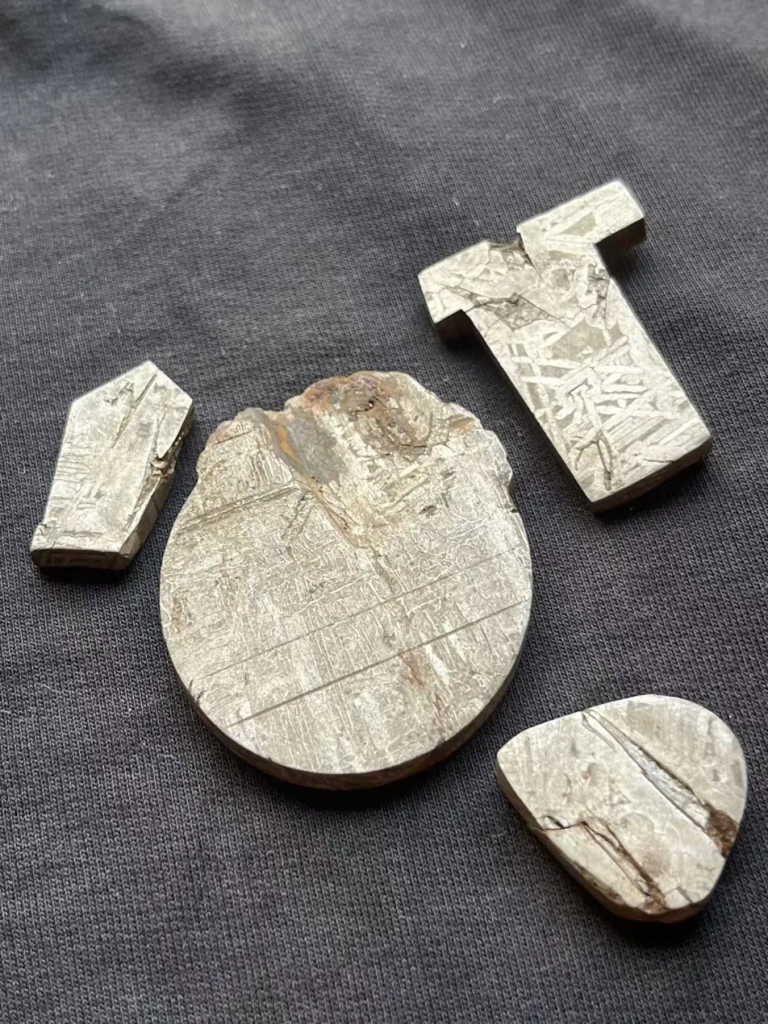
Not every cut produces a usable piece. Internal fractures that propagate during cutting, troilite inclusions that fracture and fall out, surface regions where the pattern is disrupted by ancient impact damage — all of these create pieces that cannot be used for jewelry.
The fraction of raw meteorite that becomes wearable product is significantly lower than for conventional jewelry materials. Gold can be remelted. Silver can be recast. Meteorite cannot. Every gram of material that fractures, cracks, or fails quality standards during processing is lost permanently.
This is what the finished piece carries: not just the pattern, but the specific geometry of survival. The piece in hand is the piece that made it through.
Why the Pattern Cannot Be Replicated
Laboratory replication of the Widmanstätten pattern would require cooling an iron-nickel alloy at between 10 and 40°C per million years — a process that would take tens of millions of years to complete at conditions unavailable on Earth. No industrial process achieves these cooling rates. No furnace can replicate the thermal history of a planetary core.
Simulated or printed Widmanstätten patterns exist in the market. The distinction is structural. A real pattern runs through the full depth of the material and cannot be removed without physically cutting the piece. A surface treatment stops at the surface. Acid etching a genuine piece reveals deeper structure each time. Acid applied to a fake removes the pattern entirely.
FAQ
Why can’t meteorite jewelry be resized like a gold ring? Resizing requires heat — torch work, soldering, or annealing. Any temperature above 450°C begins to destroy the Widmanstätten crystal structure. Above 700°C, the damage is complete and irreversible. Meteorite jewelry cannot be heated without risking permanent loss of the pattern.
What happens if meteorite is cut with ordinary tools? The friction from conventional abrasive cutting generates temperatures that exceed the phase transformation threshold of the iron-nickel alloy. The kamacite and taenite phases begin to re-dissolve into each other, blurring and eventually erasing the pattern. The piece may also crack unpredictably along internal Neumann line fracture planes.
Does the acid etch add anything to the surface? No. The etching process only removes material — specifically, it preferentially dissolves the kamacite phase while leaving the taenite phase intact. The pattern that becomes visible after etching was already present throughout the full depth of the metal. The acid makes existing structure visible; it does not create new structure.
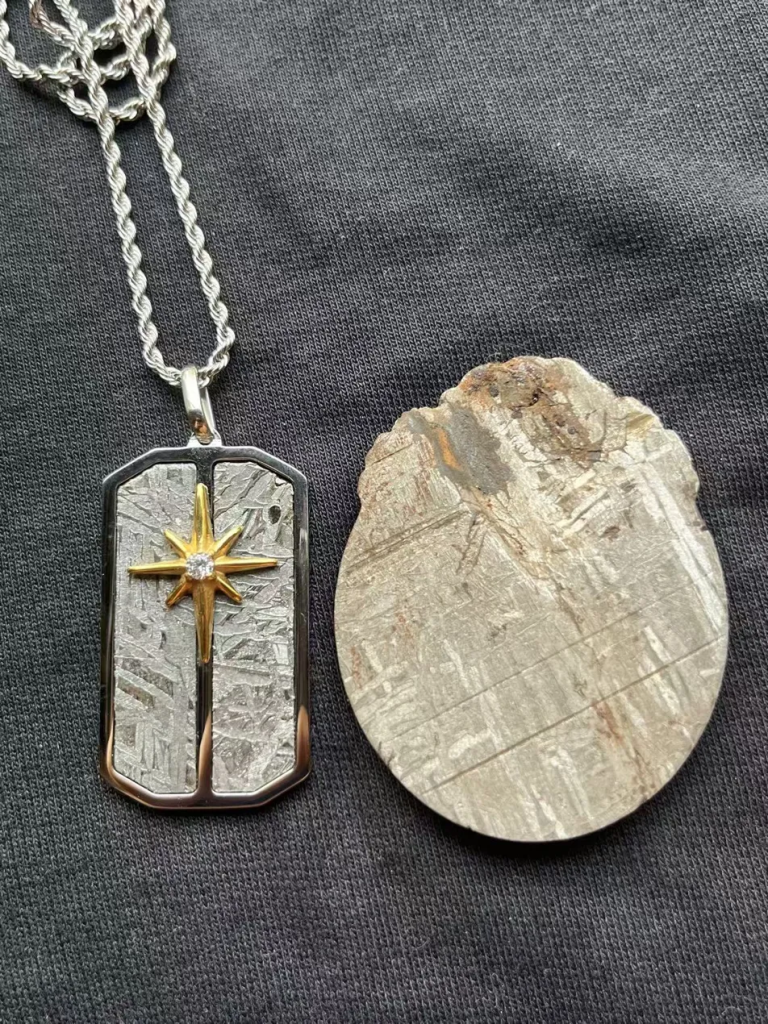
Why does every Movalor pendant look different? The Widmanstätten pattern varies continuously across the meteorite body because the crystal grew outward from multiple nucleation points simultaneously. Each cross-section through the metal cuts through a different region of the crystal network at a different orientation. No two cuts produce the same configuration.
Can a cracked or fractured meteorite piece be repaired? No. Repair would require heating the piece to bonding temperatures that destroy the Widmanstätten structure. Pieces that fracture during processing are discarded. The structural integrity of every finished piece is the result of the original material surviving the process intact — it cannot be reconstructed after the fact.
Every Movalor pendant is cut from Aletai iron meteorite — classified IIIE-an, with a kamacite bandwidth of 0.9–1.4 mm and a nickel content of 9.8 wt%. The Aletai strewn field spans about 425–430 km across Xinjiang, China. Its atmospheric entry data — a 6.5° to 7.3° angle of incidence — is documented in Li et al. 2022, Science Advances.
Explore the material: What Is the Widmanstätten Pattern? | Does Meteorite Jewelry Rust? | How to Care for Meteorite Jewelry